

NASA’s September skywatching guide highlights the Harvest Moon near Saturn on September 26, with Neptune in the same broad part of the sky. It gives readers a useful reason to plan an evening outdoors—but Indian observers should check local moonrise and weather rather than treat a general chart as an exact timetable for their city.
The NASA/JPL-Caltech guide describes the Moon rising in the east after sunset. Its accompanying diagram is a sky chart, not a photograph of a future event and not a promise of identical viewing conditions everywhere.
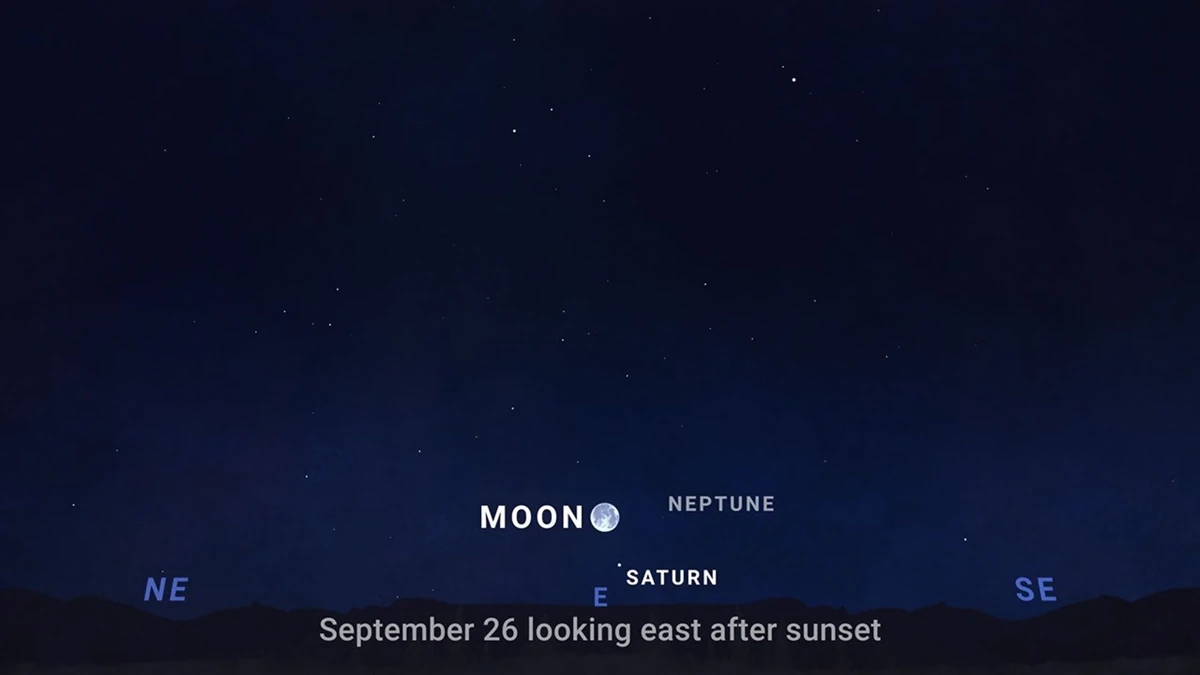
What can you see without buying equipment?
| Target | Expectation |
|---|---|
| Moon | Visible without optical equipment when above your horizon and unobscured |
| Saturn | NASA identifies it as visible to the unaided eye; rings need optical magnification |
| Neptune | Too faint for unaided-eye viewing; finding it requires optical equipment and a suitable chart |
NASA puts Neptune at approximately magnitude 8 in this guide. Do not confuse a bright object near the Moon with Neptune simply because the chart includes the planet. An apparent grouping in our sky also does not mean the objects are physically close together.
Full Moon is a phase, not a single evening’s appointment
NASA’s Moon phases explainer describes a full Moon as the phase when the sunlit side faces Earth, with the Moon opposite the Sun in our sky. The exact phase instant and the time the Moon rises where you live are different pieces of information.
That distinction is useful when comparing an overseas article with an Indian calendar. A date in an international guide should not be silently converted into a precise India-wide moonrise time. This article does not give an unverified full-Moon timestamp in IST.
A practical plan for the September 26–27 weekend
- Choose a safe location with an eastern view. Check for buildings and trees that block the horizon before making a special trip.
- Look up your city’s moonrise and cloud forecast. If you use an astronomy app, check its location and date settings before trusting the display.
- Start with the Moon and Saturn. There is no need to make Neptune the success condition for a first skywatching session.
- Record what you actually see. Note your location, observation time, cloud cover and equipment so a photo has useful context later.
Keep photographs honest
A phone image and a sky chart answer different questions. One records a scene; the other helps locate objects. If you share either, label it accurately. Do not present a magnified composite as the view everyone will see from a balcony.
Source checked September 24, 2026. The featured chart is credited to NASA/JPL-Caltech. Local sky position, moonrise and visibility vary; check them for your observing location.